
Tissue Recovery
Researchers study whether BPC-157 affects signals used when damaged tissue rebuilds itself.
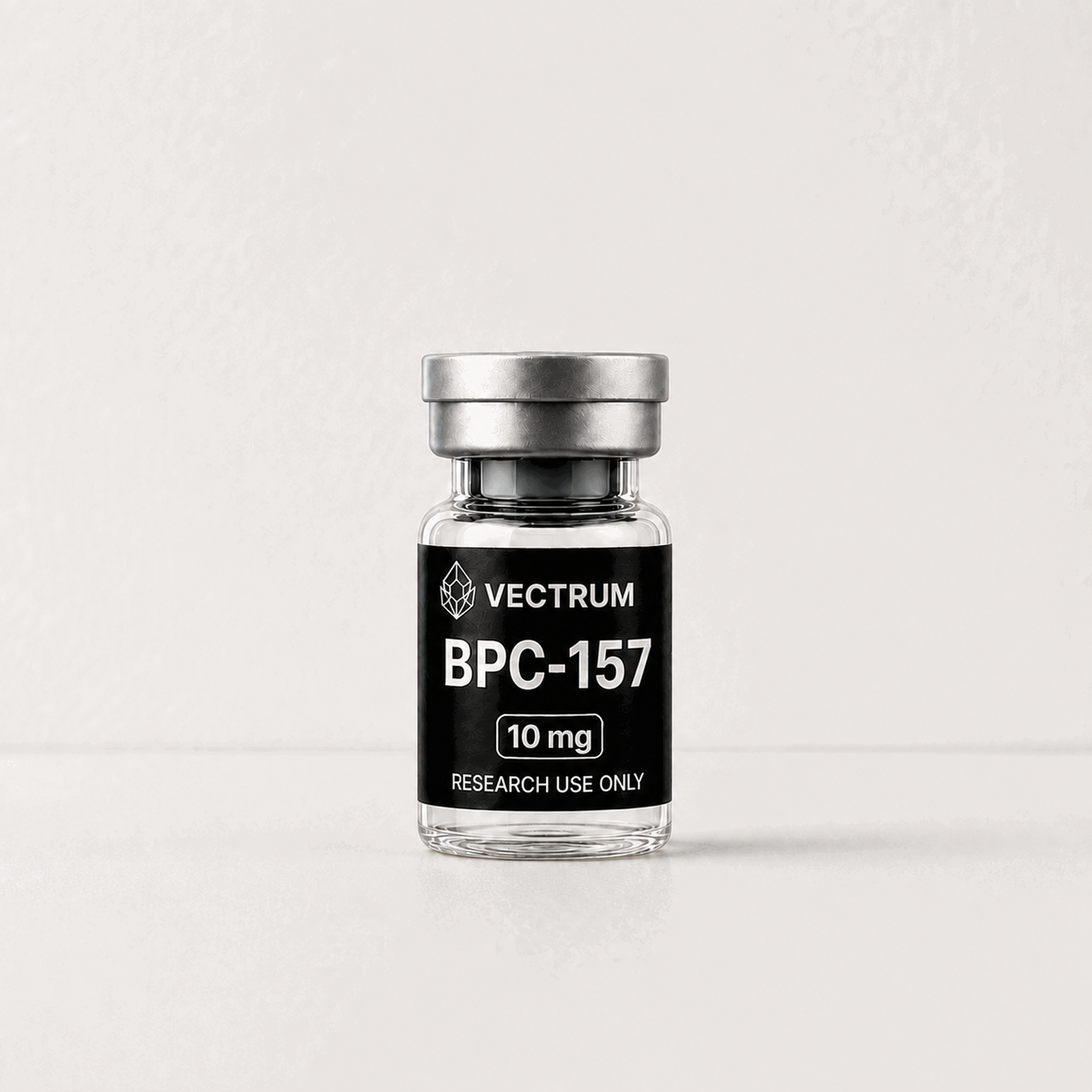
BPC-157 is a synthetic 15-amino-acid peptide. Researchers mainly use cell and animal models to study tissue-repair signals, small blood vessels and protective linings such as the digestive barrier.
At a glance
Researchers study whether BPC-157 affects signals used when damaged tissue rebuilds itself.
It is studied for how the protective lining of the stomach and intestines responds after damage.
Laboratory and animal research connects BPC-157 with signals that help small blood vessels form and restore blood flow.
Researchers study how it may affect the repair signals used by tendons and ligaments after injury.
It may affect chemical messages involved in inflammation. This has mainly been studied in laboratory and animal models.
Available separately for laboratory use.


Open the document and check that its product and batch details match your item.
This document applies only to the product and batch printed on it.
Read the supporting laboratory, animal and human research. This section does not provide instructions for human or veterinary use, diagnosis, treatment, prevention, dosage or administration.
BPC-157 is a short synthetic peptide based on a sequence described in gastric research. Scientists use it in controlled models to examine how cells respond to injury and how small blood vessels, connective tissue and protective barriers change during that response.
Normal target and function. A single direct receptor for BPC-157 has not been established. Researchers instead track systems that normally help tissue respond to stress: endothelial cells line blood vessels, nitric oxide helps those vessels change tone, VEGF helps organise new small vessels, and fibroblasts build the support framework around cells.
A major research topic is cell signalling during tissue stress. Cell signals are chemical messages that tell nearby cells how to react. BPC-157 studies have measured signals linked with blood-vessel growth, nitric oxide and the structure around cells. Researchers also examine barrier tissue, such as the lining of the digestive tract. Control groups help distinguish measured study responses from changes that can occur within an injury model.
Studies measure signals linked with endothelial cells and the formation of small vessels.
This messenger helps regulate blood-vessel behaviour and is examined in preclinical models.
Researchers track fibroblasts and extracellular matrix, the framework that supports cells.
Animal work includes stomach and intestinal injury models.
Cell studies have reported changes in endothelial movement, nitric-oxide-related signals and fibroblast activity. Rat injury and blood-flow models have reported changes in small-vessel and tissue endpoints. These observations are model-specific; they do not show that BPC-157 repairs tissue in people.
Measurements used in these studies
Published human information is limited to extremely small, uncontrolled reports. It is not reliable enough to say what a person would experience or whether BPC-157 has a human effect.
A two-person pilot did not identify changes in its selected laboratory markers, but that is far too small to establish safety or detect uncommon harms.
| Evidence type | What was studied | How much evidence | What this means |
|---|---|---|---|
| Laboratory research | Cell and signalling models | Preclinical | Researchers have examined vascular signals, fibroblast movement and related cell responses. |
| Animal research | Injury and barrier models | Preclinical | Studies report model-specific changes in blood vessels and tissue endpoints. Animal results may not translate to people. |
| Human research | Controlled clinical studies | Very limited | The sources used on this page do not provide robust controlled human evidence. |
PubMed, 2018
Review of blood-vessel and tissue-model research.
BPC-157 in a rat hind-limb ischaemia modelPubMed, 2017
Animal study of blood-vessel-related endpoints.
Two-person BPC-157 safety pilotPubMed, 2025
Extremely small uncontrolled human report; it cannot establish safety.
BPC-157 development barriersPubMed, 2026
Review of formulation, pharmacology and the severely limited human evidence.