
Collagen
GHK-Cu is studied for how skin cells produce collagen. Collagen gives skin and other tissues strength and structure.
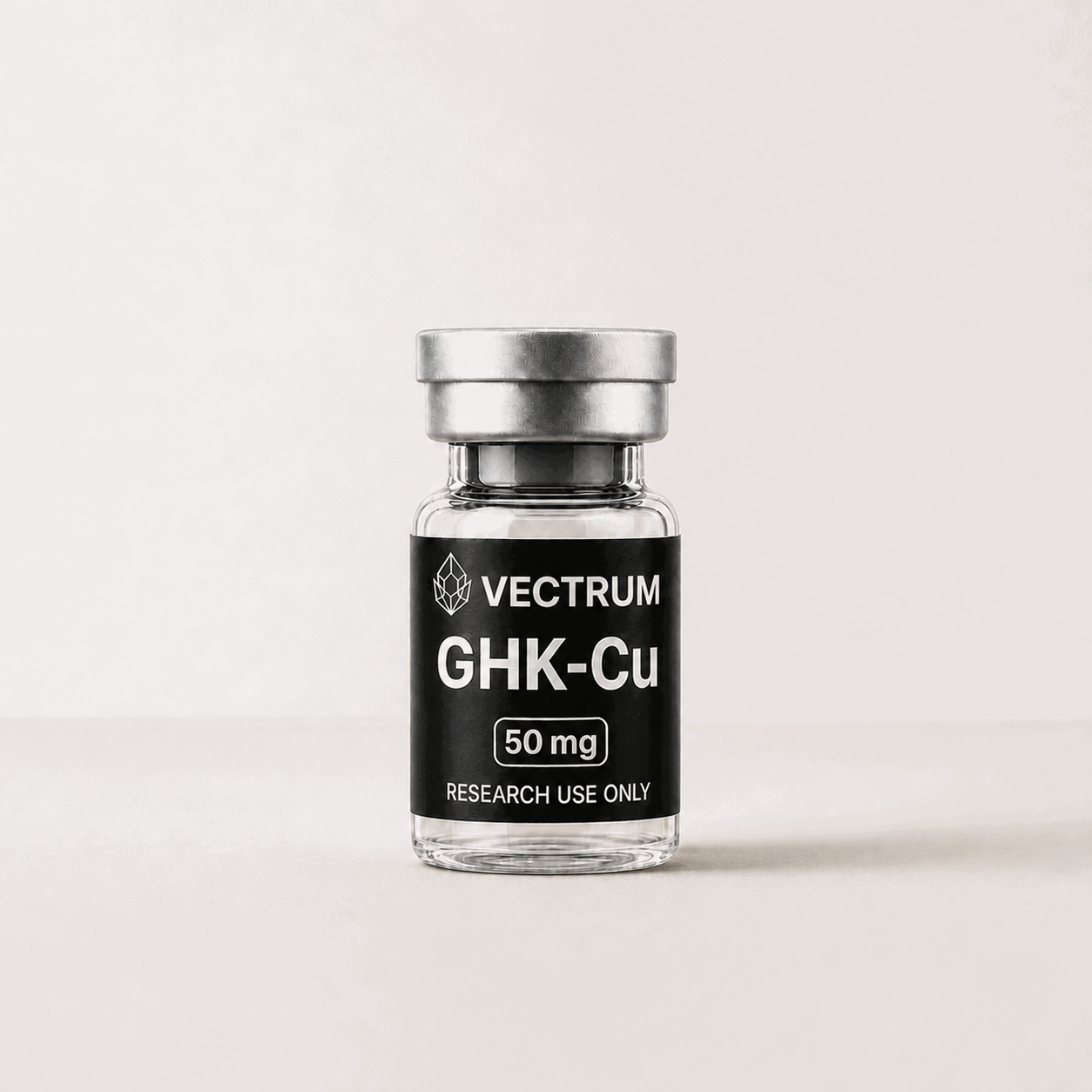
GHK-Cu is a short peptide bound to copper. Researchers study how it relates to collagen, skin structure, cell movement and the material that supports tissues.
At a glance
GHK-Cu is studied for how skin cells produce collagen. Collagen gives skin and other tissues strength and structure.
It may affect proteins that help skin stay firm and supported, including collagen and material around skin cells.
Researchers study how GHK-Cu affects skin-cell movement and repair signals after tissue damage.
Skin elasticity means how well skin stretches and returns to shape. GHK-Cu is studied for signals that support this structure.
Available separately for laboratory use.


Open the document and check that its product and batch details match your item.
This document applies only to the product and batch printed on it.
Read the supporting laboratory, animal and human research. This section does not provide instructions for human or veterinary use, diagnosis, treatment, prevention, dosage or administration.
GHK-Cu is a complex formed when the three-amino-acid peptide GHK binds copper. Researchers study it because copper takes part in many enzymes and because GHK-Cu can be examined as a cell-signalling complex. Published work includes chemistry, cell culture and animal wound models.
Normal target and function. GHK binds copper rather than acting through one confirmed receptor. Copper is a normal cofactor for enzymes involved in connective-tissue structure, antioxidant chemistry and cell metabolism. Fibroblasts normally make collagen and other extracellular-matrix material, while endothelial cells line blood vessels.
The main topic is the relationship between copper handling and the extracellular matrix, the network that gives cells and tissues support. In experiments, researchers measure how GHK-Cu relates to collagen signals, cell movement, oxidative stress and inflammatory messages. They also track endothelial cells, which line blood vessels. Researchers compare results across models, concentrations and formulations, with copper alone and the copper-free peptide serving as useful controls.
The GHK peptide can bind copper ions, creating the complex studied in biochemical work.
Cell studies measure collagen and other parts of the support network around cells.
Fibroblast and endothelial-cell responses are tracked in controlled experiments.
Some models examine oxidative and inflammatory signalling, with results tied to the test conditions.
Chemistry, cell and animal studies have reported changes in copper handling, collagen-related signals, cell movement and wound-model markers. The result depends on the formulation and test system, so it cannot establish a cosmetic or medical effect for raw GHK-Cu.
Measurements used in these studies
One randomised study followed 13 people using topical skin-care regimens after carbon-dioxide laser resurfacing. Objective assessment found no significant GHK-Cu advantage for redness, wrinkles or overall skin quality. Participants using the GHK-Cu regimen reported higher satisfaction. This was a tiny study of finished topical products, not this reference material.
Product boundary. The study used complete topical skin-care regimens after a medical procedure. It does not establish the identity, delivery, safety or performance of this vial.
| Evidence type | What was studied | How much evidence | What this means |
|---|---|---|---|
| Laboratory research | Chemistry and cell models | Preclinical | Copper binding and several matrix-related cell signals have been studied. |
| Animal research | Controlled wound models | Preclinical | Animal studies measured vascular and tissue markers. These results are model-specific. |
| Human research | 13-person topical study | Very limited | No objective advantage was found for redness, wrinkles or overall skin quality; participant satisfaction was higher. This does not establish an outcome for raw GHK-Cu. |
PubMed, 2006
Small randomised human study with no objective advantage on the main skin assessments.
Review of GHK and copper-peptide researchPubMed, 2022
Background on copper binding and experimental tissue markers.
GHK-Cu in a controlled scald-wound modelPubMed, 2017
Animal study of vascular and repair-related markers.
GHK-Cu and inflammatory signallingPubMed, 2016
Cell and controlled-model work involving oxidative and inflammatory signals.