
Weight Loss
Human studies found large average reductions in body weight. Most of the weight lost came from body fat, although results differed between people.
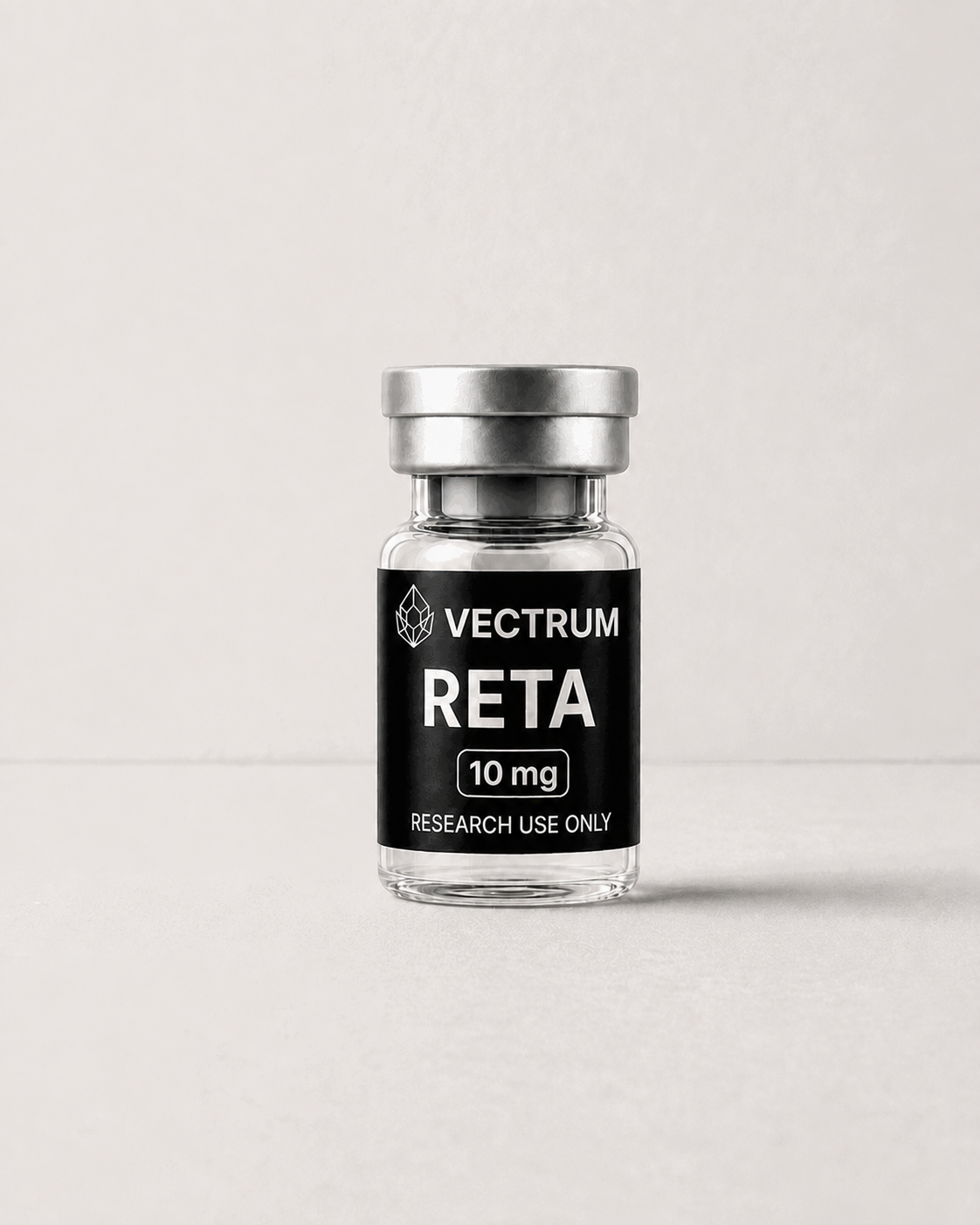
Retatrutide is an investigational peptide that activates GLP-1, GIP and glucagon receptors. These hormone systems affect hunger, digestion, insulin, blood sugar and energy use.
At a glance
Human studies found large average reductions in body weight. Most of the weight lost came from body fat, although results differed between people.
It affects hunger and fullness signals. People may feel less hungry, become full sooner and find it easier to eat less.
It helps the body release insulin when blood sugar rises. This can improve how the body handles sugar after eating.
Research found reductions in stored body fat and fat inside the liver. The liver helps process and store energy.
It affects hormone signals involved in how the body uses food and stored energy.
Available separately for laboratory use.


Open the document and check that its product and batch details match your item.
This document applies only to the product and batch printed on it.
Read the supporting laboratory, animal and human research. This section does not provide instructions for human or veterinary use, diagnosis, treatment, prevention, dosage or administration.
Retatrutide is an investigational peptide that can signal through the GLP-1, GIP and glucagon receptors. This product page identifies the 10 mg laboratory reference format. Research on the molecule ranges from receptor-structure work to animal models and phase 2 and phase 3 trials in people.
Normal target and function. After food, GLP-1 signalling can slow stomach emptying and reduce hunger signals, while GLP-1 and GIP help the pancreas release insulin when glucose is present. The glucagon receptor helps release stored fuel and maintain glucose supply. Retatrutide activates all three systems, so researchers measure the combined changes in blood glucose, appetite-related signals and body weight.
The three target receptors are part of the body's system for managing food-related signals, glucose and stored energy. Researchers study whether a single peptide can produce a useful, balanced pattern across all three. Laboratory work maps how the molecule contacts each receptor and which messages follow inside cells. Human trials have measured metabolic and body-weight outcomes.
One part of the research examines a receptor involved in food-related and glucose signals.
A second receptor connects nutrient sensing with metabolic cell responses.
The third receptor is involved in glucose supply and energy regulation.
Phase 2 and phase 3 studies measure body weight, blood sugar and safety outcomes for the investigational drug.
Structural and cell studies show how retatrutide contacts and activates each receptor. Animal models reported changes in glucose and energy-related endpoints that supported later trials. Those findings explain the research pathway but do not prove the performance of this 10 mg research presentation.
Measurements used in these studies
Phase 2 trials in obesity and type 2 diabetes and a published 2026 phase 3 diabetes trial found lower body-weight and blood-glucose measurements with an investigational retatrutide product. The studies do not turn retatrutide into an approved medicine or establish equivalence for this storefront material.
Product boundary. The trials used controlled pharmaceutical formulations and monitored protocols. The catalogue amount “10 mg” is a product descriptor, not a dosing instruction or proof of trial-product equivalence.
| Evidence type | What was studied | How much evidence | What this means |
|---|---|---|---|
| Laboratory research | Receptor structure and signalling | Mechanistic | The three receptor interactions have been examined in controlled laboratory systems. |
| Animal research | Metabolic response models | Preclinical | Animal findings helped shape clinical research but are not direct human evidence. |
| Human research | Controlled phase 2 and phase 3 trials | Meaningful investigational evidence | Trials reported changes in blood-glucose and body-weight measures. They do not establish an approved use or this listing's equivalence. |
PubMed / Lancet, 2026
Controlled human trial reporting HbA1c, body-weight and safety outcomes.
Triple-receptor retatrutide phase 2 trialPubMed / NEJM, 2023
Human research with an investigational retatrutide product.
Retatrutide phase 2 metabolic studyPubMed, 2023
Controlled investigational research in people.
Structural basis of triple-receptor signallingPubMed, 2024
Laboratory work showing how retatrutide contacts its receptors.
FDA status of unapproved retatrutide productsFDA
Current regulatory status; retatrutide has not been found safe and effective for any condition by FDA.
Appetite and eating-behaviour analysisPubMed, 2025
Exact-compound phase 2 questionnaire results for hunger, fullness and eating behaviour.
Retatrutide liver-fat substudyPubMed, 2024
Randomized phase 2a MRI study in participants with raised liver fat.
Retatrutide body-composition substudyPubMed, 2025
Human trial substudy separating total fat mass from lean mass by scan.