
Focus and Attention
Semax is studied for brain signals involved in attention and focus.
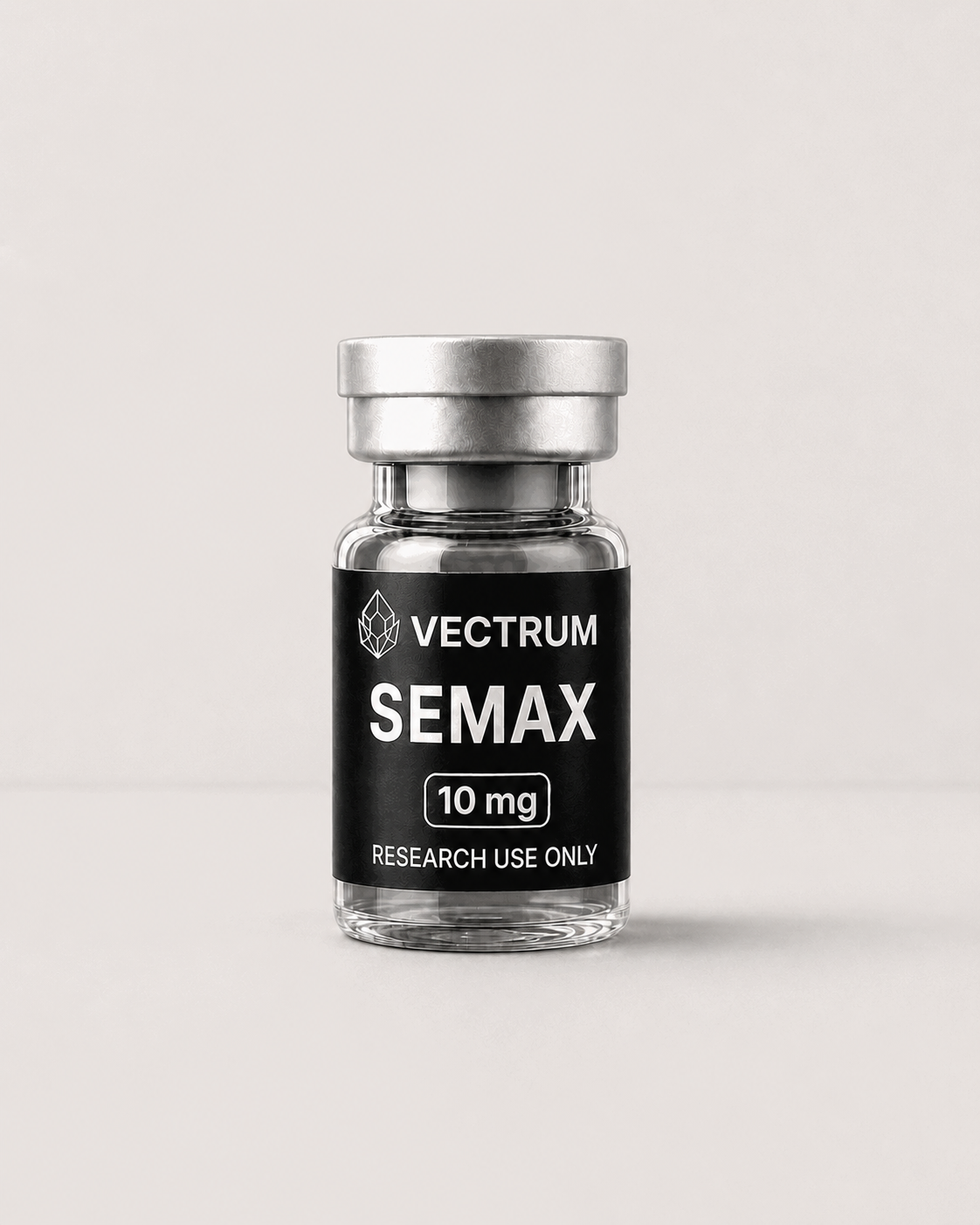
Semax is a synthetic peptide based on part of the natural ACTH molecule. Researchers mainly use laboratory and animal models to study nerve-cell stress, communication and adaptation.
At a glance
Semax is studied for brain signals involved in attention and focus.
Researchers study whether Semax affects signals used in learning and memory.
It is connected to brain pathways involved in mental energy and fatigue.
Semax is studied for signals that help brain cells adapt and communicate after stress or injury.
Available separately for laboratory use.


Read the supporting laboratory, animal and human research. This section does not provide instructions for human or veterinary use, diagnosis, treatment, prevention, dosage or administration.
Semax is a synthetic peptide based on a short fragment of ACTH, a natural hormone, but it is studied for different signalling questions rather than normal ACTH hormone activity. Research includes brain gene activity, BDNF-related signals and animal models of reduced blood flow. One human report also studied Semax during rehabilitation after ischaemic stroke.
Normal target and function. Semax does not have one confirmed human receptor target. Preclinical work follows BDNF, a natural protein that helps nerve cells survive and adapt, and TrkB, the receptor that receives BDNF signals. Researchers also track broad gene responses after experimental brain-tissue stress.
Researchers use Semax models to ask how nerve cells change their gene activity after stress. One measured signal is BDNF, a protein involved in the maintenance and adaptation of nerve cells. Rat studies have examined TrkB, a receptor that responds to BDNF, and gene expression after experimental ischaemia. Separately, a 110-person post-stroke rehabilitation report measured blood BDNF, movement and everyday independence.
Animal studies measure a nerve-cell support signal called brain-derived neurotrophic factor.
TrkB receives BDNF signals and is tracked in some rat brain experiments.
Researchers compare which genes become more or less active after an experimental challenge.
Published sources include animal models of reduced blood flow to brain tissue.
Rat studies have reported changes in BDNF/TrkB-related signals and patterns of gene activity after experimental ischaemia or other controlled stress. These are molecular and animal observations, not evidence of better memory, mood, focus or recovery in people.
Measurements used in these studies
The sources used here are molecular or animal studies. They do not provide reliable controlled human results for memory, mood, attention, recovery or another body-level outcome.
Reliable human adverse-effect information for this Semax research material is not established.
| Evidence type | What was studied | How much evidence | What this means |
|---|---|---|---|
| Laboratory research | Gene-expression analysis | Preclinical | Studies report changes in selected molecular signals under controlled conditions. |
| Animal research | Rat brain and ischaemia models | Preclinical | BDNF-related and gene-expression endpoints have been measured in rats. |
| Human research | Post-stroke rehabilitation | Early and limited | A 110-person report measured daily-function scores, movement and plasma BDNF. It did not test healthy focus, memory or energy. |
PubMed, 2006
Animal study measuring selected neural signals.
Semax and BDNF expression in ratsPubMed, 2006
Preclinical work in a selected brain region.
Gene activity in a rat ischaemia modelPubMed, 2017
Transcriptome research after controlled brain-tissue stress.
Semax during post-stroke rehabilitationPubMed, 2018
Clinical report measuring Barthel daily-function scores, movement and plasma BDNF.